
Many townhouse projects in Indonesia run on tight schedules and limited site space. I often meet contractors who ask if a 3.5m³ self loading mixer machine can support 60–90m³ of concrete per day. The answer depends on how you plan the work, the travel distance, and the pour sequence. In this post, I will walk you through real numbers, practical scenarios, and tips that help you decide with confidence.
Understanding Your Daily Concrete Demand
Your first step is to look at the actual daily pour requirement. Most townhouse blocks need 60–90m³/day during peak phases such as footing, tie beams, and floor slabs. Since the demand fluctuates, you need a mixer that gives stable output even when the weather, traffic flow, or manpower changes.
Before choosing the model, you should also check the working hours allowed on site. Many Indonesian urban projects work 8–10 hours per day. Because of that, you must calculate output per hour, not only per batch. This is where the logic becomes clearer.
Concrete Output Calculation for a 3.5m³ Self Mixer
Our 3.5m³ self load concrete mixer for sale produces 3.5m³ per batch. One full working hour usually allows 4 batches. Therefore, the output is 3.5 × 4 = 14m³ per hour. With a 10-hour shift, the theoretical daily output reaches 140m³. However, real projects always include delays, washing intervals, loading time differences, and site layout factors. Because of these variables, I recommend calculating at 70–80% of the theoretical figure. That gives you around 95–110m³/day of realistic output.
Since this range covers your 60–90m³/day requirement, the 3.5m³ model becomes a strong match. But let’s look deeper to ensure the match is truly suitable for townhouse construction.
Why a 3.5m³ Car Mixer Fits Most Townhouse Projects
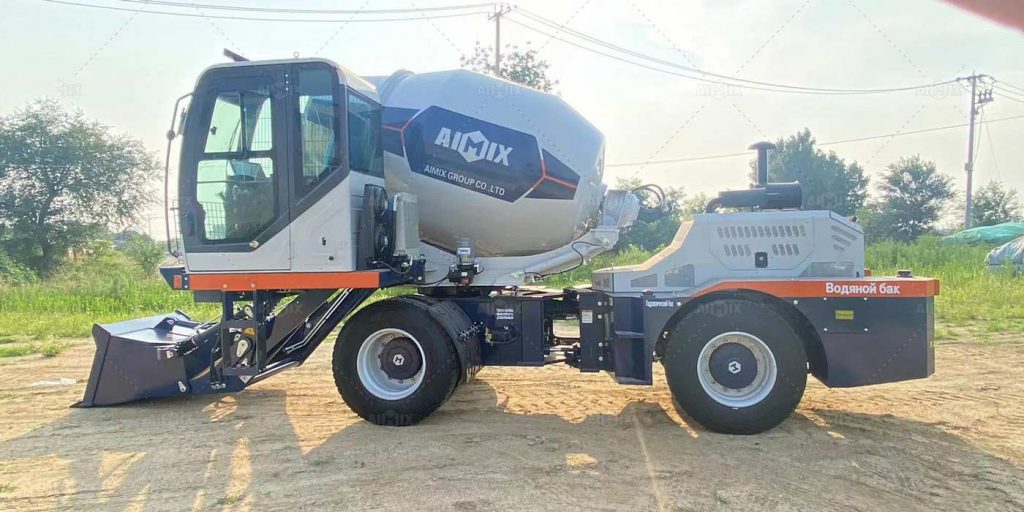
Townhouse sites usually have narrow access roads, limited staging areas, and workers who need consistent concrete flow. As the project grows, every delay affects the entire block. Because of that, your equipment must support stable production without requiring excessive site space. A 3.5m³ mixer fits this logic well.
Moreover, the mixer combines loading, mixing, weighing, and transportation in one unit. That reduces the need for extra manpower and eliminates the risk of inconsistent manual batching. Since townhouse projects involve repeated small-to-medium pours, this helps keep quality stable from footing to roof slab.
Short Haul Distances Improve Output Stability
Most townhouse developments have tight clusters of units. Because of that, travel time per batch stays short. Shorter cycles mean you maintain steady output throughout the day. Real users in Indonesia often report cycle times between 12–18 minutes per batch. This rhythm supports the earlier 95–110m³/day real-world production range.
Therefore, if your project layout keeps haul distance within 100–300 meters, the 3.5m³ mixer performs very efficiently.
When a 3.5m³ Self Loading Mixer Might Not Be Enough
Although the 3.5m³ model works for most townhouse jobs, you should still check a few exceptions. Some sites have long ramps, uneven ground, or very steep internal roads. These issues slow down each cycle. As a result, your daily output may drop below target.
Another scenario is when multiple blocks pour on the same day without a break. If your project requires continuous concrete flow for 10–12 hours without pause, you may need two units working together. This ensures no crew needs to wait and avoids cold joints. Since townhouse slabs often require precise timing, this consideration becomes important.
Comparing with Larger Models
If your site demands more than 90–110m³/day, or if you want stronger production buffers, the 4.0m³ or 5.5m³ models give you higher output per cycle. However, they need more maneuvering space. That is why I always check the road width, turning radius, and platform size before recommending the switch to a bigger mixer.
Choosing the Right Model for Your Project
By now, you can see the logic clearly. A 3.5m³ self loading mixer meets the daily requirement of many Indonesian townhouse developments. It offers high hourly production, fast loading, easy operation, and consistent concrete quality. At the same time, it fits narrow roads and maximizes efficiency in small and medium clusters.
However, since every project has unique conditions, your final choice should align with site layout, pour schedule, and labor planning. Thinking through these points helps you avoid delays and unexpected costs. After all, concrete supply is one of the most time-sensitive parts of a townhouse project.
Why Many Indonesian Contractors Choose My AIMIX Self Mixers
Because townhouse projects in Indonesia need both speed and accuracy, I focus on giving customers mixers that solve real on-site problems. My self loading mixers include digital weighing, 4×4 wheel drive, and strong engines designed for continuous work in hot and dusty environments. They deliver consistent batches and reduce your reliance on external supply trucks. More importantly, they help your team maintain a steady workflow from morning to evening.
If you want to check whether the 3.5m³ model fits your project, you can contact me anytime. I can help you calculate the daily output based on your actual site distance, working hours, and pour sequence, then recommend the best option for your townhouse blocks.
No responses yet