
For contractors handling road construction, residential developments, and industrial projects, buying a concrete batching plant involves more than choosing a production capacity. Each project has different concrete requirements, construction schedules, site conditions, and delivery challenges. A plant that performs well on a housing project may not provide the same efficiency when supplying a highway construction site or a large industrial facility.
This creates an important purchasing question: should contractors buy separate batching plants for different applications, or invest in one versatile concrete production system that can serve multiple projects?
For companies with a diverse project portfolio, the right choice can improve equipment utilization, reduce repeated investment, and create more flexible concrete supply arrangements. However, a multi-application plant must match the actual production requirements of each project. Buyers need to consider peak concrete demand, mixing requirements, plant mobility, material storage, installation time, and future expansion before making a decision.
This guide explains how to evaluate these factors and select a suitable batching plant machine that supports road, housing, and industrial construction without creating unnecessary operating costs or production bottlenecks.
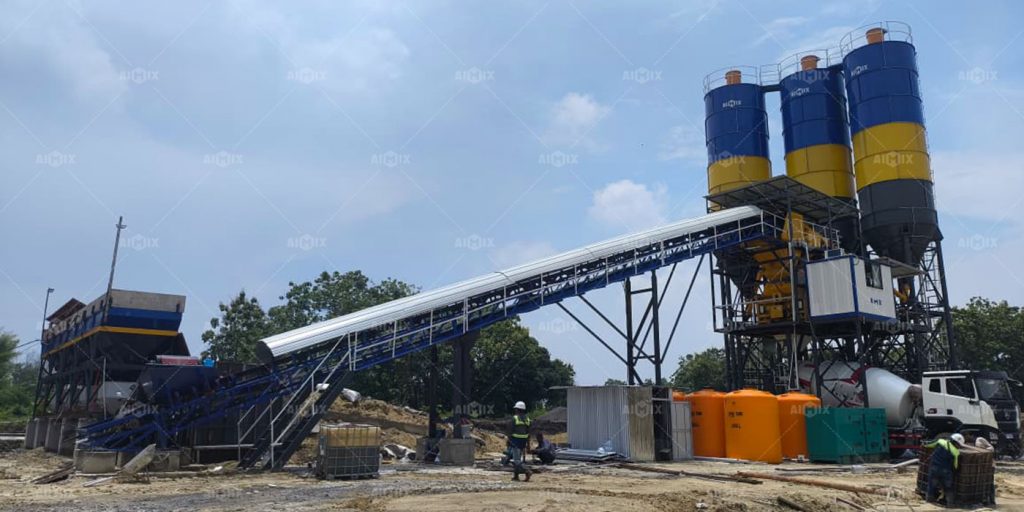
Why Do Multiple Construction Applications Require Different Batching Plant Configurations?
Although road, housing, and industrial projects all consume concrete, their production patterns can be very different. Some contractors need a steady concrete supply throughout the working day. Others require large volumes during specific construction stages. Therefore, selecting equipment based only on total monthly concrete consumption can lead to an unsuitable investment.
Road Construction: Continuous Supply and Project Mobility
Road construction often involves long working distances and multiple construction sections. Contractors may produce concrete for rigid pavements, drainage systems, culverts, bridges, retaining structures, and roadside facilities.
Unlike a building project with a relatively concentrated construction area, a road project may move forward as different sections reach the construction stage. This creates several equipment selection requirements:
- Stable concrete production during scheduled paving operations.
- Enough capacity to match the concrete placement rate.
- Suitable aggregate storage for continuous production.
- Efficient truck loading and transportation arrangements.
- Practical relocation options when the construction front changes.
- Reliable batching controls for different concrete mix requirements.
For example, a contractor building a concrete road may need to coordinate the batching plant with concrete trucks, paving equipment, and finishing crews. If the plant produces too slowly, the paving team may wait. If production exceeds transportation capacity, trucks may create unnecessary queues.
Therefore, road contractors should select capacity according to the actual paving schedule and delivery cycle rather than the total road length alone.
Housing Construction: Flexible Production for Multiple Building Stages
Residential construction usually involves several concrete activities throughout the development process. These include foundations, columns, beams, slabs, stairs, drainage, and access roads.
However, concrete demand does not remain constant. Foundation work may create concentrated demand during the early stage. Later, slab and structural work may require different production schedules.
For housing contractors, a suitable batching plant should provide:
- Flexible production for different house types and structural designs.
- Suitable capacity for several simultaneous concrete pours.
- Accurate material weighing and consistent mix proportions.
- A compact layout that fits residential construction sites.
- Reasonable installation and operating costs.
For instance, a contractor building 15 houses per month may not need a large industrial-scale batching plant. However, if the company also supplies concrete to nearby housing developments, a higher production capacity may offer better long-term value.
Industrial Projects: Higher Volume and More Demanding Production Schedules
Industrial construction introduces another set of requirements. Factories, warehouses, power facilities, industrial parks, and processing plants can involve large foundations, equipment bases, structural frames, floors, and heavy-duty concrete pavements.
Some industrial projects require substantial concrete volumes within limited construction windows. Others need consistent production over several months.
Buyers should pay particular attention to:
- Peak hourly and daily concrete demand.
- Required concrete grades and mix designs.
- Large foundation and floor slab pouring schedules.
- Aggregate, cement, and admixture storage capacity.
- Equipment reliability and maintenance arrangements.
- Future production requirements after the initial construction phase.
As a result, an industrial project may justify a larger plant or a more comprehensive configuration than a small residential development, even when both projects have similar construction durations.
How Should Buyers Calculate the Required Production Capacity?
After identifying the application, buyers should calculate how much concrete the plant needs to produce. This is one of the most important steps because an incorrect capacity selection can affect every subsequent operating decision.
A plant that is too small can delay concrete placement and increase labor costs. Conversely, an oversized plant may consume more capital, require additional operators, and remain underutilized during normal production periods.
Start With Peak Daily Concrete Demand
First, estimate the total concrete volume required for each project. Then identify the busiest production days rather than relying only on the average monthly demand.
A simple calculation is:
Required practical production rate = Peak daily concrete demand ÷ Effective production hours per day.
For example, assume a contractor needs 360 m³ of concrete on a busy construction day and has six effective production hours.
360 m³ ÷ 6 hours = 60 m³/h.
This means the plant must achieve approximately 60 m³/h of actual production to meet the planned demand. Because real operations involve interruptions, material replenishment, truck movements, and maintenance, buyers should also consider an appropriate operating margin.
Understand Rated Capacity Versus Actual Output
Manufacturers usually specify batching plant capacity in cubic meters per hour. However, the rated figure does not guarantee the same output under every site condition.
Actual production depends on several factors:
- Concrete mixer capacity and mixing cycle.
- Aggregate feeding and weighing efficiency.
- Cement and water supply arrangements.
- Number of concrete mix designs.
- Truck loading and transportation cycles.
- Operator experience and equipment maintenance.
Therefore, buyers should request realistic production estimates based on their intended concrete mix, working hours, and material supply conditions. A supplier should explain the assumptions behind the quoted capacity.
Compare Different Capacity Requirements Across Applications
The following table provides illustrative capacity ranges for initial equipment planning. These are not fixed specifications. Actual selection depends on peak demand, project duration, working hours, and production arrangements.
| Project Application | Indicative Capacity Range | Main Selection Priority |
|---|---|---|
| Small residential construction | 25–40 m³/h | Compact layout and flexible production |
| Medium housing developments | 40–60 m³/h | Daily demand and simultaneous pours |
| Medium road construction | 50–90 m³/h | Continuous supply and transportation |
| Large road and bridge projects | 90–120 m³/h or higher | Peak production and placement schedules |
| Industrial construction | 60–120 m³/h | Structural concrete demand and reliability |
| Large industrial and multi-project supply | 120–180 m³/h or higher | High-volume production and future expansion |
For buyers serving several applications, the important question is whether the highest-demand project requires the plant to operate near maximum capacity every day. If so, the equipment may leave insufficient flexibility for other contracts.
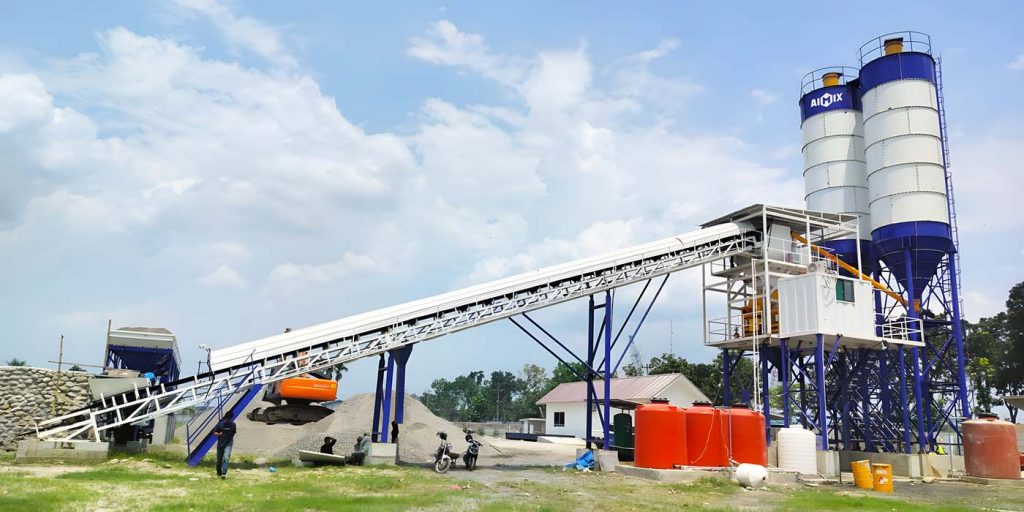
Should You Choose One Multi-Purpose Plant or Separate Batching Plants?
Once buyers understand the production requirements, they need to decide how to organize concrete production across different projects. There are two common approaches: using one plant for multiple applications or installing separate plants for different construction locations.
Option 1: One Plant Serving Multiple Projects
A single batching plant can be a practical investment for contractors whose projects operate in the same region or follow different construction schedules.
For example, a contractor may complete a residential foundation project before starting a new road construction contract. The same plant can potentially support both projects if its capacity, configuration, and location arrangements meet their requirements.
Advantages include:
- Lower initial equipment investment compared with purchasing several complete plants.
- Better utilization when projects have different production periods.
- Centralized equipment maintenance and operator management.
- Potential savings in spare parts and equipment management.
- Greater flexibility for contractors with changing project portfolios.
However, this approach also has limitations. If two projects require large concrete volumes at the same time and are located far apart, one plant cannot efficiently serve both locations. Transportation and relocation costs may eliminate the expected savings.
Option 2: Separate Plants for Different Projects
Separate batching plants may be more practical when projects operate simultaneously, require different production capacities, or have considerable distances between construction sites.
For example, a company may operate a stationary plant near an industrial park while using a mobile concrete batch plant for sale for a temporary road project.
This arrangement can provide:
- Independent production schedules for different projects.
- Reduced concrete transportation distances.
- Less competition for production capacity.
- Better control over project-specific concrete requirements.
The disadvantage is the higher capital requirement. Buyers must also manage additional operators, maintenance, spare parts, and site arrangements.
How to Make the Right Decision
The choice should depend on project location, production overlap, and expected equipment utilization.
| Business Situation | Recommended Direction |
|---|---|
| Several projects in the same region with different schedules | Consider one versatile plant. |
| Road and housing projects operating simultaneously | Compare separate production lines or plants. |
| Long-term industrial production at one location | Consider a stationary plant. |
| Temporary projects in different locations | Evaluate mobile equipment and relocation costs. |
| Growing concrete supply business | Consider modular expansion or additional production lines. |
Stationary or Mobile: Which Plant Configuration Fits Multiple Applications?
Capacity alone does not determine whether a batching plant can serve different projects. Its physical configuration also affects installation, transportation, material handling, and operating efficiency.
Therefore, buyers should evaluate whether a stationary, mobile, or fast-installation design better matches their project portfolio.
Stationary Concrete Batching Plant for Long-Term Production
A stationary concrete batching plant generally suits contractors who maintain a fixed production location for an extended period.
It can support road infrastructure bases, industrial parks, commercial developments, and ready-mix concrete operations. A fixed layout also provides more opportunities to arrange aggregate storage, cement silos, loading areas, and internal vehicle routes according to production requirements.
Buyers should consider this configuration when:
- The project will operate at one location for a long period.
- Daily concrete demand remains relatively stable.
- The site has sufficient space for material storage.
- The contractor needs a long-term concrete production base.
- Future expansion may require additional storage or production capacity.
Mobile Concrete Batching Plant for Changing Project Locations
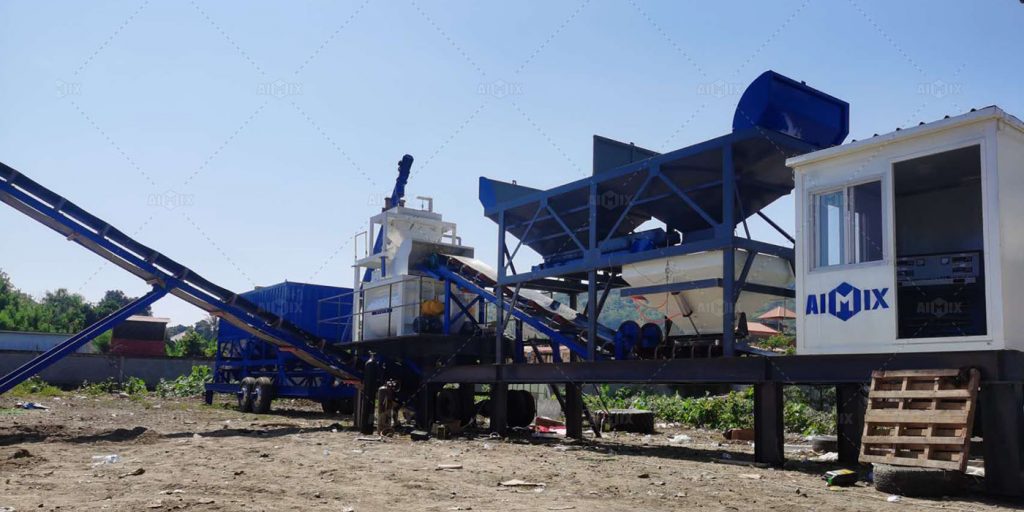
A mobile concrete batching plant is worth considering when contractors frequently move between construction sites.
For example, a road contractor may complete one section and then move equipment to another location. A mobile configuration can simplify transportation and reduce some of the work involved in setting up a new production site.
However, buyers should not assume that every mobile plant can move without preparation. Transportation permits, lifting arrangements, site access, utility connections, and recommissioning still require planning.
Before purchasing, ask the manufacturer to explain the actual dismantling, transportation, installation, and startup procedures.
Fast Installation Solutions for Tight Construction Schedules
Some contractors need to establish concrete production quickly because the project schedule leaves little time for extensive site preparation.
In this situation, a fast-installation or foundation-free configuration may be worth evaluating. Depending on the design, it can reduce certain civil construction requirements and shorten the preparation process.
This option may benefit temporary road projects, housing developments, and industrial construction sites where early concrete production has significant schedule value.
Nevertheless, buyers should confirm the actual foundation requirements, ground-bearing conditions, equipment support arrangements, and local construction regulations before choosing this design.
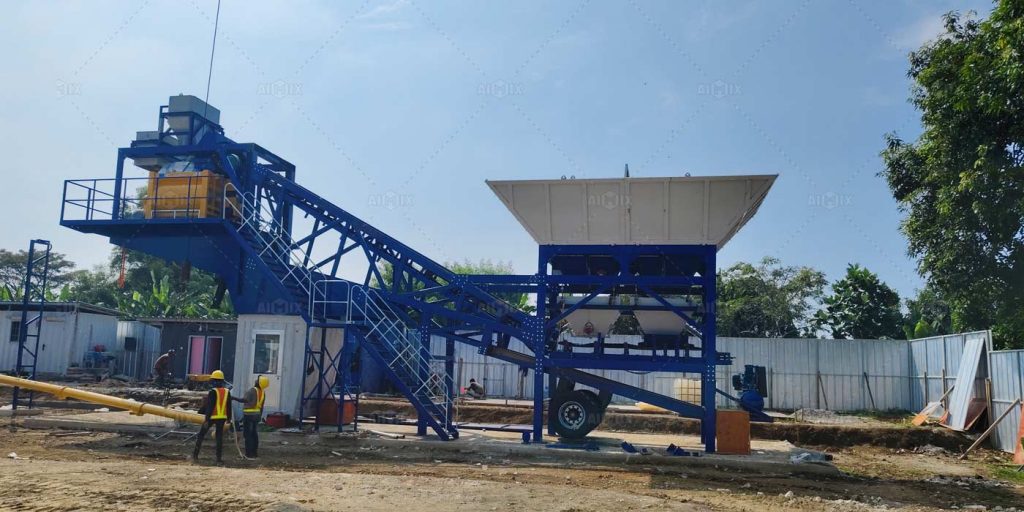
Does One Batching Plant Need to Produce Different Concrete Grades?
When a contractor handles road, housing, and industrial projects, the plant may need to produce several concrete grades and mix designs.
For example, residential foundations may require different concrete specifications from industrial floors or structural road components. Some projects may also use specialized mixes with different aggregate sizes, admixtures, or water-cement ratios.
Consequently, the batching plant must support the required mix designs and provide reliable material measurement.
Check the Weighing and Dosing System
Accurate batching helps maintain consistent concrete quality. Buyers should check the weighing systems for aggregates, cement, water, and admixtures.
The control system should allow operators to select approved mix recipes and manage changes between production orders. It should also support production records where project specifications or quality management procedures require them.
Consider Aggregate Storage and Feeding
Different construction applications may require different aggregate sizes and proportions. Road concrete, building foundations, and industrial structures may not use identical aggregate combinations.
Therefore, buyers should evaluate the number of aggregate storage bins, feeding arrangements, and available storage capacity.
Insufficient storage can interrupt production when material deliveries arrive late. A well-planned aggregate system helps the plant maintain a more stable operating schedule.
Choose a Mixer That Matches the Concrete Requirements
The mixer is another important part of the selection process. Buyers should consider batch size, mixing cycle, required concrete consistency, and the range of mix designs.
A compulsory twin-shaft mixer is commonly considered for construction applications that require consistent concrete mixing. However, the final choice should follow the concrete specifications and manufacturer’s technical recommendations rather than the mixer name alone.
How Can Buyers Avoid Overspending on a Multi-Application Batching Plant?
A versatile plant does not necessarily need the largest available capacity or the most complex configuration. In fact, excessive equipment investment can reduce profitability when actual project demand remains below the plant’s production capability.
Buyers should evaluate the total cost of ownership instead of comparing purchase prices alone.
Calculate Equipment Utilization Across All Projects
Start by estimating how many hours the plant will operate on each project. Then combine the expected operating periods to calculate annual utilization.
For example, a contractor may have the following annual workload:
- Road construction: 700 operating hours.
- Residential construction: 450 operating hours.
- Industrial construction: 350 operating hours.
The total expected operating time is 1,500 hours per year. This gives the buyer a more useful basis for evaluating equipment investment than looking at each contract separately.
However, these hours must reflect actual production schedules. The contractor should also account for maintenance, relocation, idle periods, and overlapping projects.
Compare the Total Cost of Ownership
A complete investment calculation should include:
- Initial equipment purchase price.
- Transportation and installation expenses.
- Foundation and site preparation costs.
- Electricity or fuel consumption.
- Operators and maintenance personnel.
- Wear parts and spare parts.
- Aggregate and cement storage arrangements.
- Relocation and recommissioning expenses.
- Equipment depreciation and potential resale value.
After calculating these costs, buyers can compare the estimated cost per cubic meter with the alternative of purchasing ready-mix concrete from external suppliers.
For contractors working in remote areas, transportation and supply reliability may significantly affect the comparison. In urban areas, traffic and delivery scheduling may also influence the cost of external concrete supply.
When comparing quotations, buyers should also evaluate the batching plant supplier in terms of equipment configuration, installation support, warranty coverage, spare parts availability, and after-sales service. A lower initial quotation does not always mean a lower long-term operating cost.
Keep Future Expansion in Mind
Some contractors initially purchase a batching plant for their own construction projects. Later, they may expand into commercial ready-mix supply or undertake larger infrastructure contracts.
In these circumstances, an expandable configuration may provide better long-term value than purchasing an oversized plant immediately.
Buyers can discuss additional aggregate bins, cement silos, material feeding systems, automation functions, and possible production line expansion with the manufacturer before finalizing the equipment layout.
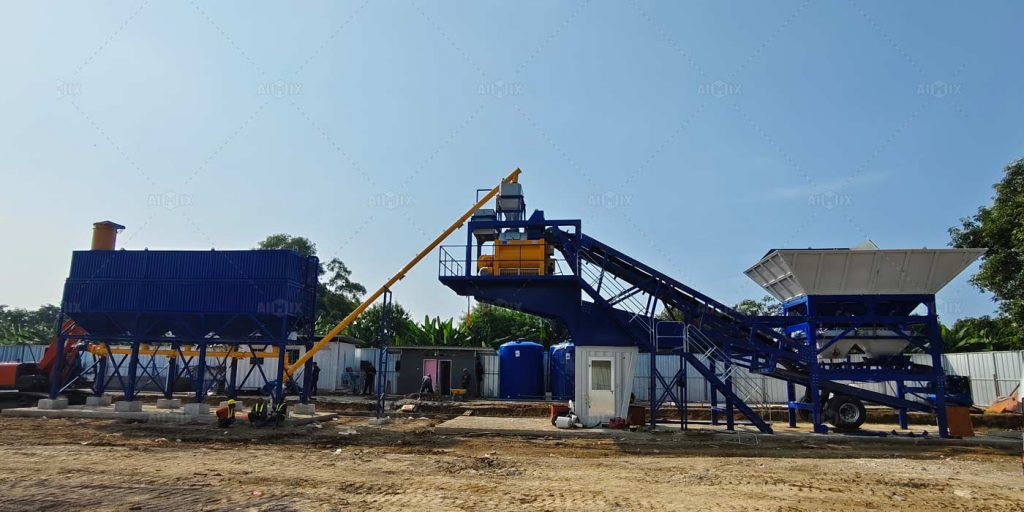
What Should Buyers Check Before Requesting a Batching Plant Quotation?
Once the main technical requirements are clear, buyers should prepare a project brief for the equipment supplier. This helps avoid quotations that look similar in price but include different configurations and installation scopes.
For contractors handling multiple applications, the following information is particularly useful.
Project and Production Information
- What types of projects will the plant serve?
- How many road, housing, and industrial contracts are planned?
- What is the total concrete demand for each application?
- What is the peak hourly and daily production requirement?
- How many working hours are available each day?
- Will different projects operate simultaneously?
- How many concrete grades or mix designs are required?
Site and Installation Information
- Where will the batching plant operate?
- How much installation space is available?
- What are the ground and foundation conditions?
- Is a stable electricity and water supply available?
- Will the plant remain at one location or move between projects?
- What are the transportation and site access limitations?
Commercial and Service Requirements
- What is the available equipment investment budget?
- When must concrete production begin?
- Does the project require installation and operator training?
- What spare parts and maintenance support are available locally?
- Will the contractor need future capacity expansion?
Providing these details allows the supplier to evaluate the entire production requirement instead of recommending equipment based on a single capacity figure.
Why Local Service and Installation Support Matter for Multi-Project Contractors
When one batching plant supports several construction applications, equipment downtime can affect more than one contract. A production interruption during a highway pour, residential foundation schedule, or industrial concrete operation can create additional costs.
Therefore, buyers should evaluate the supplier’s service capabilities alongside the equipment specifications.
Installation and Commissioning
Ask whether the supplier can provide installation guidance, commissioning support, and operator training. Confirm which installation activities belong to the equipment supplier and which require local contractors.
Spare Parts Availability
Check the availability of common wear parts, weighing components, electrical components, sensors, and other maintenance items. Long spare-part waiting times can create unnecessary production interruptions.
Technical Assistance During Operation
A reliable support arrangement helps operators solve production problems and maintain the plant. This becomes particularly important when contractors operate in several locations or have limited in-house maintenance experience.
For international projects, buyers should also confirm communication channels, service response arrangements, warranty conditions, and the availability of local technical assistance.
A Practical Selection Strategy for Road, Housing, and Industrial Contractors
For buyers managing different construction applications, the best approach is to select equipment according to the complete project portfolio rather than treating every contract as an isolated investment.
Consider the following practical selection strategy:
- For road contractors: Prioritize peak paving demand, continuous supply, truck coordination, and relocation requirements.
- For housing developers: Prioritize flexible production, compact site layout, different structural concrete requirements, and investment recovery.
- For industrial contractors: Prioritize large pouring capacity, reliable production, aggregate and cement storage, and long-term operating stability.
- For multi-project companies: Evaluate overlapping schedules, annual utilization, relocation costs, and future expansion before deciding between one plant and multiple plants.
Most importantly, do not assume that a single plant can serve every project simply because its rated capacity appears sufficient. The complete system must also match the material supply, transportation, concrete placement, and quality requirements of each application.
Conclusion: Choose a Batching Plant Around Your Project Portfolio
Selecting a concrete batching plant for road, housing, and industrial applications requires a broader investment perspective. Buyers need to understand how each project consumes concrete, when peak production occurs, where the plant will operate, and whether different contracts will compete for the same production capacity.
A stationary plant may provide a practical solution for long-term production at a fixed location. A mobile configuration may suit contractors who frequently change project sites. Meanwhile, a fast-installation solution can help reduce the time required to establish production when construction schedules are tight.
There is no universal capacity or configuration that fits every contractor. The most economical choice is the one that meets actual production requirements, maintains reliable concrete quality, and achieves reasonable utilization across the company’s project portfolio.
At AIMIX, we help construction companies evaluate concrete batching plant solutions according to their project applications, production targets, site conditions, and investment plans. Whether you undertake road construction, residential development, industrial building, or several types of projects simultaneously, our team can help assess a suitable plant capacity and configuration.
Planning to purchase a concrete batching plant for multiple construction applications? Contact AIMIX with your project locations, required concrete output, application types, working schedules, and relocation requirements. Our team can help you compare suitable production capacities and configurations, so you can invest in equipment that supports both your current contracts and future business development.
No responses yet