
Indonesia continues to invest heavily in highways, bridges, railways, ports, and urban infrastructure. As a result, demand for precast concrete girders is growing rapidly across the country. Contractors and precast manufacturers face increasing pressure to deliver high-quality girders on time while controlling production costs.
In this situation, choosing the right concrete batching plant Indonesia becomes a critical decision. A suitable concrete batching plant not only improves concrete consistency but also increases production efficiency and reduces material waste. Therefore, understanding which batching plant best fits precast girder production can help project owners achieve better results.
So, which batching plant is the ideal choice for precast girder production in Indonesia? The answer depends on several important factors, including production volume, project duration, concrete strength requirements, and site conditions.
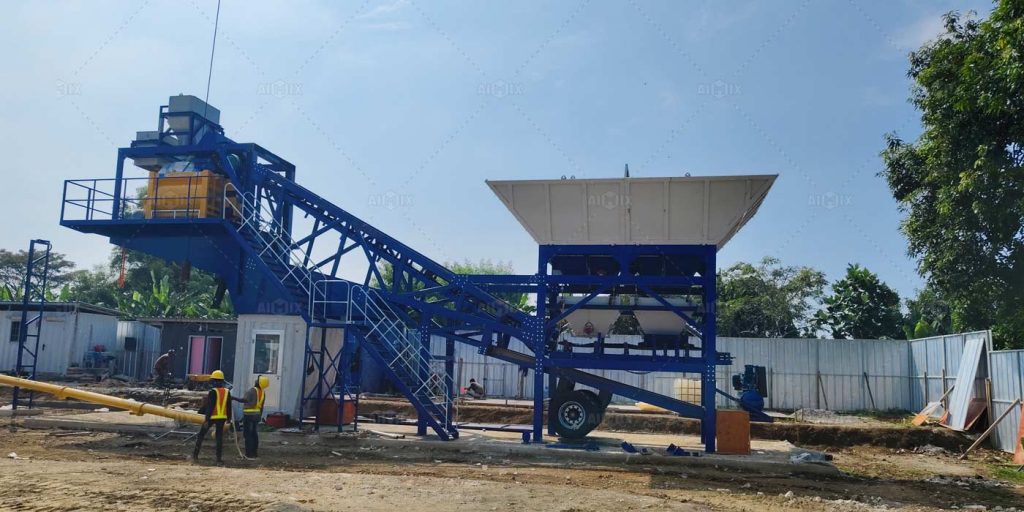
Why Does Precast Girder Production Require a Specialized Batching Plant?
Before selecting equipment, it is important to understand the unique characteristics of precast girder manufacturing.
Unlike ordinary building projects, precast girder production requires strict control over concrete quality. Each girder must meet specific strength and dimensional requirements. Even small variations in the concrete mix can affect structural performance.
Moreover, girder factories often operate continuously. They produce multiple girders every day and follow tight delivery schedules. Therefore, the batching plant must provide stable output and accurate batching.
For example, a precast yard producing 8–15 bridge girders per day may consume 150–300 m³ of concrete daily. Larger infrastructure projects may require more than 500 m³ per day.
As a result, the batching plant must deliver consistent concrete while supporting high production efficiency.
Key Factors When Selecting a Batching Plant for Precast Girders
Now that we understand the production requirements, let’s examine the factors that influence batching plant selection.
Daily Concrete Demand
The first consideration is daily concrete consumption.
If the precast facility produces only a few girders per day, a smaller batching plant may be sufficient. However, large bridge projects usually require higher concrete output.
- 100–150 m³/day: 35–50 m³/h batching plant
- 150–300 m³/day: 60–90 m³/h batching plant
- 300–600 m³/day: 120–180 m³/h batching plant
- More than 600 m³/day: 180–240 m³/h batching plant
Therefore, production planning should come before equipment selection.
Concrete Strength Requirements
Precast girders often use high-strength concrete ranging from 40 MPa to 60 MPa or even higher.
Because of this, batching accuracy becomes extremely important. Cement, water, aggregates, and admixtures must be weighed precisely.
Consequently, a ready mixed concrete batching plant equipped with an advanced weighing system and automatic control system can significantly improve concrete quality.
Production Continuity
Many Indonesian infrastructure projects operate under strict schedules.
If concrete supply stops unexpectedly, production delays can occur. In addition, mold utilization decreases and labor costs increase.
Therefore, contractors should choose a batching plant with reliable components, stable performance, and easy maintenance.
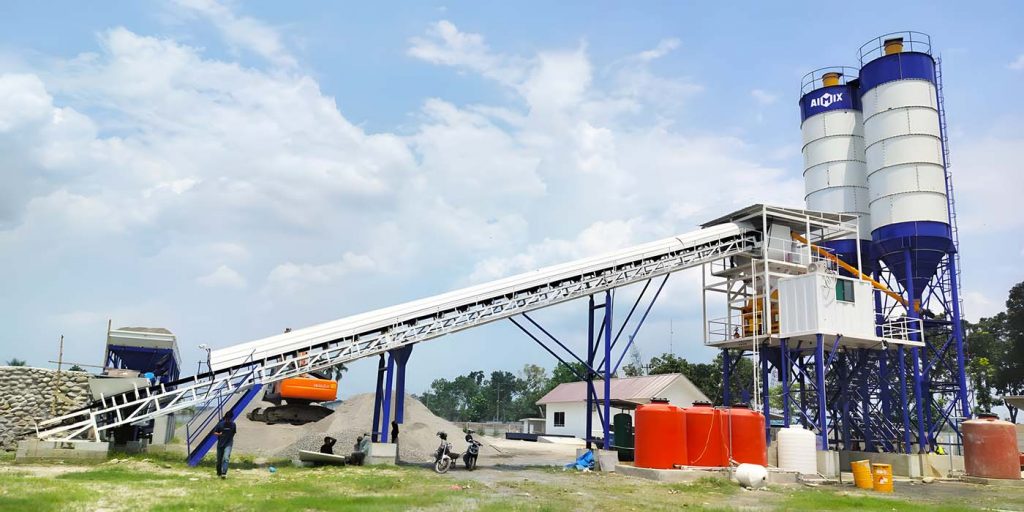
Which Types of Batching Plants Are Commonly Used for Precast Girder Production?
After identifying project requirements, the next step is selecting the most suitable plant type.
Stationary Concrete Batching Plants
Stationary batching plants are the most common choice for precast girder factories.
These plants offer high productivity, stable operation, and excellent batching accuracy. Since precast yards usually remain in one location for several years, stationary plants provide long-term value.
Typical capacities include:
- AJ-60: 60 m³/h
- AJ-90: 90 m³/h
- AJ-120: 120 m³/h
- AJ-180: 180 m³/h
For most bridge girder projects in Indonesia, a 90–120 m³/h stationary batching plant offers a good balance between investment and productivity.
Twin Shaft Mixer Batching Plants
For high-strength precast concrete, twin shaft mixers are particularly popular.
These mixers create intensive mixing action and produce highly uniform concrete.
Furthermore, they handle low water-cement ratios effectively. This capability is essential for producing durable bridge girders.
As a result, many large precast manufacturers prefer twin shaft mixer plants for demanding infrastructure projects.
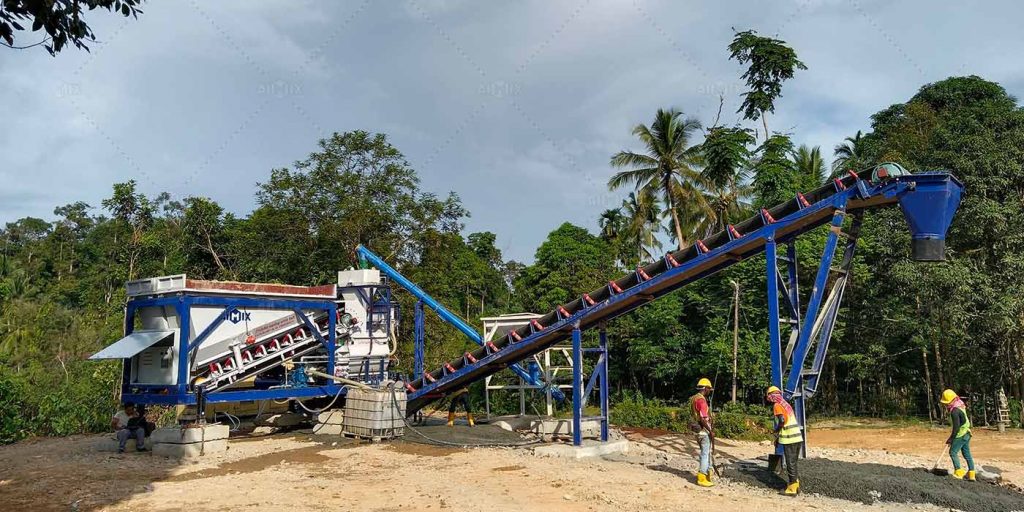
Mobile Batching Plants
In some cases, contractors establish temporary precast yards near project sites.
Under these circumstances, mobile batching plants may be a practical option.
They offer faster installation and easier relocation. However, their capacity is generally lower than large stationary plants.
Therefore, they are better suited for medium-sized projects or short-term production needs.
What Plant Capacity Is Suitable for Indonesian Girder Projects?
Capacity selection often depends on project scale. Fortunately, several practical scenarios can help guide the decision.
Municipal Bridge Projects
Municipal bridges typically require moderate girder production.
A 60–90 m³/h batching plant usually meets production demands while maintaining cost efficiency.
Expressway Construction Projects
Indonesia’s toll road network continues to expand.
For expressway projects producing hundreds of girders, a 120 m³/h batching plant is often the preferred solution.
It supports continuous production while providing enough capacity for future demand increases.
Large National Infrastructure Projects
Major railway, highway, and port projects often require large quantities of precast components.
In these cases, a 180 m³/h batching plant or larger may deliver the best return on investment.
Higher output reduces production bottlenecks and helps contractors meet tight construction schedules.
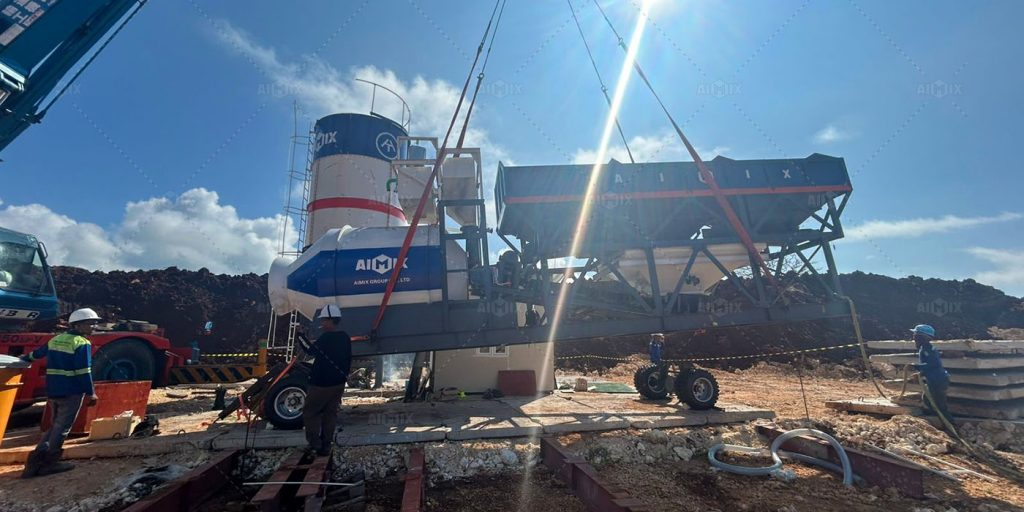
How Can the Right Batching Plant Improve Project Profitability?
Equipment selection affects more than concrete production.
In fact, the right batching plant can directly influence project profitability.
First, accurate batching reduces material waste. Cement savings alone can generate significant cost reductions over long production periods.
Second, stable concrete quality minimizes rejected girders and rework costs.
Third, reliable production helps contractors meet delivery deadlines and avoid project penalties.
Finally, automated systems reduce labor requirements and improve operational efficiency.
Therefore, investing in the appropriate batching plant often produces long-term financial benefits.
Conclusion: Choosing the Best Batching Plant for Precast Girder Production in Indonesia
The ideal batching plant for precast girder production depends on project scale, daily concrete demand, concrete strength requirements, and production schedules.
For most Indonesian precast girder manufacturers, stationary batching plants equipped with twin shaft mixers and capacities ranging from 90 m³/h to 120 m³/h provide an excellent combination of productivity, concrete quality, and investment efficiency.
Meanwhile, larger infrastructure projects may benefit from 180 m³/h or higher-capacity solutions to support continuous production and future expansion.
If you are planning a bridge, highway, railway, or precast manufacturing project in Indonesia, selecting the right batching plant is one of the most important decisions you will make. A properly matched solution can improve concrete quality, increase production efficiency, and help maximize your project’s profitability.
Looking for a batching plant solution for your precast girder project in Indonesia? Contact our team today if you want to buy a concrete batching plant. We can help you evaluate your production requirements and recommend the most suitable batching plant configuration for your specific project needs.
No responses yet