
Industrial estate construction often involves several concrete-intensive works at the same time. These may include factory buildings, warehouses, roads, drainage systems, foundations, retaining structures, and utility facilities. Therefore, choosing a concrete batching plant is not simply about selecting the largest capacity available.
A 60 m³/h concrete batching plant di Indonesia can be enough for many industrial estate projects. However, the real question is whether its output matches your daily concrete demand, project schedule, and site conditions.
For contractors, developers, and ready-mix suppliers, this capacity can offer a practical balance between production capacity, investment, transport, and site efficiency. The key is to calculate the actual demand before making a decision.
How Much Concrete Does an Industrial Estate Project Need?
The first step is to estimate the project’s concrete consumption.
Industrial estate projects can have very different concrete requirements. A small factory cluster may need several hundred cubic meters per week. A large industrial park may require thousands of cubic meters during peak construction.
For example, consider a project that needs:
- 480 m³ of concrete per day.
- 8 hours of planned concrete production.
- 60 m³/h plant capacity.
In theory, a 60 m³/h plant can produce up to 480 m³ in 8 hours.
However, real production rarely reaches the rated capacity continuously. Loading delays, aggregate moisture, truck waiting time, mix changes, maintenance, and site traffic can reduce actual output.
Therefore, contractors should not plan around 100% utilization.
A practical operating rate of around 70% to 85% can provide a more realistic estimate.
At 75% utilization, a 60 m³/h plant can deliver around 45 m³/h of effective production. Over an 8-hour production period, that equals approximately 360 m³/day.
This figure provides a better basis for project planning.
When Is a 60 m³/h Batching Plant Enough?
A 60 m³/h plant can work well when the project’s average demand remains within its practical production range.
1. Factory Building Construction
Factory projects usually involve foundations, columns, beams, floors, and equipment bases.
Concrete demand can rise sharply during foundation and floor construction. However, demand may fall after major structural works finish.
Therefore, a 60 m³/h plant can suit projects with moderate peak demand.
It also gives contractors more control over concrete supply. They do not need to depend entirely on external ready-mix suppliers.
2. Warehouse and Logistics Facilities
Large warehouses often require extensive slab work.
The concrete pour may involve hundreds of cubic meters within a short period. In this case, production planning becomes critical.
A 60 m³/h plant can support continuous concrete supply when enough mixer trucks are available.
For example, a project requiring 300 to 350 m³ during an 8-hour working day can fit well within the practical range of a 60 m³/h plant.
3. Industrial Estate Roads and Drainage
Industrial estates also require internal roads, drainage channels, culverts, curbs, and utility structures.
These works often have a more distributed concrete demand.
As a result, a 60 m³/h plant can provide sufficient capacity while avoiding excessive investment in an oversized plant.
Moreover, the plant can support several work zones from one centralized production point.
When Is 60 m³/h Not Enough?
Although 60 m³/h can be suitable, it is not the right choice for every project.
The main issue is peak demand, rather than average demand.
Suppose a large industrial estate requires 700 to 900 m³ of concrete during a single major pouring operation.
A 60 m³/h concrete ready mix plant for sale would theoretically need more than 11 hours to produce 700 m³. Real operating conditions would extend this time further.
That could create problems for:
- Large foundation pours.
- Continuous floor slab casting.
- High-volume structural concrete.
- Multiple simultaneous construction zones.
- Strict concrete placement schedules.
In these situations, a higher-capacity plant may provide better project control.
A 90 m³/h, 120 m³/h, or larger batching plant may reduce production time and improve peak-period reliability.
How Should Contractors Calculate the Required Capacity?
Instead of choosing a plant based only on the project name, calculate the concrete demand.
A simple approach is:
Required Plant Capacity = Peak Daily Concrete Demand ÷ Effective Production Hours
For example, if the project needs 500 m³ during a peak day and plans to operate for 10 hours:
500 ÷ 10 = 50 m³/h
At first glance, a 60 m³/h plant appears sufficient.
However, the calculation should include a production buffer. If actual utilization reaches only 75% to 85%, the plant may struggle to maintain the schedule.
Therefore, contractors should compare the calculated demand with effective output, not only rated output.
This approach prevents a common procurement mistake. A plant may look sufficient on paper but fail to provide enough concrete during real construction conditions.
What Other Factors Affect 60 m³/h Plant Performance?
Capacity is important, but it is not the only factor.
Mixer Truck Availability
A batching plant cannot maintain production if trucks cannot remove concrete quickly.
For a 60 m³/h plant, contractors should coordinate truck capacity, travel distance, loading time, and unloading time.
If trucks spend too long waiting at the construction site, plant utilization falls.
Aggregate Supply
The plant also needs a stable supply of sand, gravel, and other aggregates.
Therefore, aggregate storage should match the planned production rate.
A shortage of aggregate can stop concrete production even when the batching plant itself works normally.
Cement and Admixture Supply
Cement storage also matters during intensive construction periods.
A sufficient silo capacity can reduce interruptions. Automated weighing and dosing systems can also improve consistency between batches.
Site Layout
Industrial estates can cover large areas.
The distance between the batching plant and concrete pouring location affects truck cycle time. A centralized plant may work well for a compact project. A large industrial park may require additional logistics planning.
Therefore, site layout should be considered before final equipment selection.
Is a 60 m³/h Plant Economical for an Industrial Estate?
For many medium-scale industrial projects, the answer can be yes.
A 60 m³/h plant avoids some of the investment and infrastructure requirements associated with a much larger plant.
It can also reduce idle capacity when concrete demand varies throughout the project.
However, the lowest initial investment does not always mean the lowest project cost.
If the plant cannot keep up with peak demand, contractors may face:
- Longer concrete pouring periods.
- Higher labor costs.
- Increased truck waiting time.
- More complicated scheduling.
- Delays to subsequent construction activities.
- Greater dependence on external concrete suppliers.
Therefore, contractors should evaluate the total project cost, rather than only the equipment purchase price.
60 m³/h vs. Higher-Capacity Batching Plants
The right capacity depends on the project’s production profile.
A 60 m³/h plant is generally more suitable for moderate and relatively stable demand. A larger plant becomes more attractive when peak concrete demand is high.
For example:
- Up to 300–350 m³/day: 60 m³/h can often provide a practical production solution.
- Around 400–600 m³/day: 60 m³/h may work with extended operating hours and efficient logistics.
- Above 600 m³/day: Consider a higher-capacity plant or multiple production units.
- 700–1,000+ m³/day peaks: A 90–120 m³/h or larger solution may offer better scheduling flexibility.
These figures are planning references rather than fixed limits. Actual output depends on operating efficiency, mix design, truck cycles, material supply, and working hours.
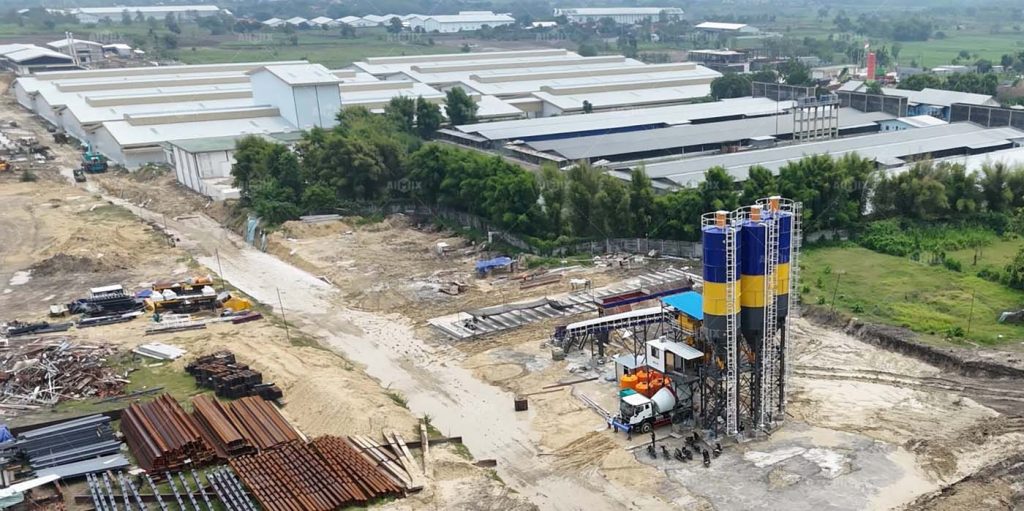
Should You Choose a 60 m³/h Batching Plant?
For many industrial estate construction projects, 60 m³/h is a practical middle-ground capacity.
It can support factory buildings, warehouses, internal roads, drainage, foundations, and other concrete works. More importantly, it can provide enough production without creating excessive unused capacity.
However, the best choice depends on your peak daily concrete demand.
Before purchasing, calculate your required m³/day. Then evaluate operating hours, truck availability, aggregate supply, site distance, and project deadlines.
If your project requires around 300–500 m³/day, a 60 m³/h plant may be a strong option. If your project regularly requires 700 m³ or more in a short period, consider increasing plant capacity.
Plan Your Concrete Production Before Buying
The right batching plant should support your construction schedule, not simply meet a specification sheet.
For an industrial estate project, start with the concrete demand of your busiest construction phase. Then work backward to determine the required hourly output.
A 60 m³/h batching plant can be a smart choice when the production demand, logistics, and working hours align with its practical capacity.
If you are planning an industrial estate, factory, warehouse, or infrastructure project, share your estimated concrete demand, daily working hours, and project type. A suitable batching plant configuration can then be selected around your actual construction needs rather than an oversized or undersized capacity. Get to know the overall concrete batching plant price at right!
No responses yet