
For small contractors in Indonesia, buying a compact concrete batching plant is not simply an equipment purchase. It is a business decision. The real question is whether the plant can reduce concrete supply costs, improve project scheduling, and generate enough production volume to recover the investment.
This question matters because Indonesian contractors often work on residential buildings, commercial projects, warehouses, industrial facilities, roads, drainage systems, and other small to medium construction projects. Some sites are close to ready-mix suppliers. Others are located far from major cities, on islands, in mountainous areas, or in developing construction zones where concrete supply is less convenient.
In these situations, a compact concrete batching plant for sale can give contractors more control over when and where concrete is produced. However, profitability does not come simply from owning the equipment. It depends on concrete demand, plant utilization, material costs, transportation conditions, project duration, and the number of projects the contractor can serve.
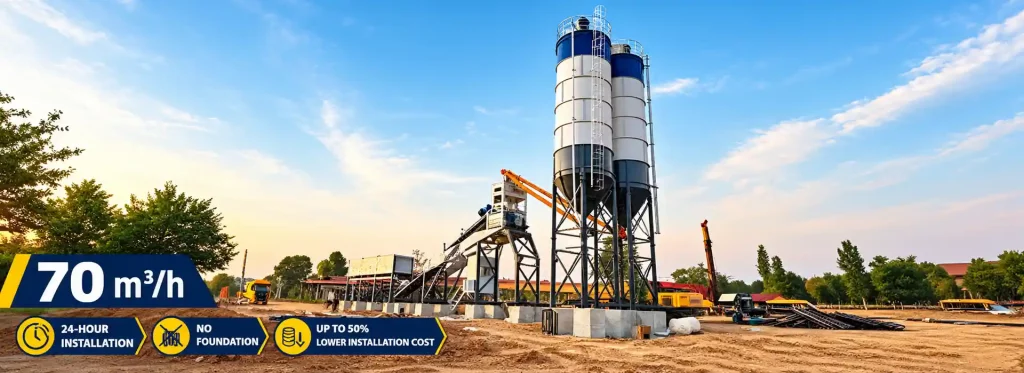
Why Are Small Contractors Looking at Compact Concrete Batching Plants?
The first issue is usually concrete supply. When a contractor buys ready-mix concrete from an external supplier, the quoted concrete price is only part of the actual project cost.
For example, a construction site may be 30, 50, or even more than 100 km from a reliable ready-mix supplier. The contractor then has to consider delivery distance, truck availability, traffic, waiting time, and the risk of delayed concrete placement.
These issues become more important when the project requires regular concrete pouring. Therefore, on-site production can become attractive when the contractor needs a more stable supply of concrete.
- Remote projects may have limited ready-mix suppliers.
- Long transportation distances can increase delivered concrete costs.
- Traffic can affect concrete delivery schedules.
- Small projects may not receive the same delivery priority as large projects.
- Concrete delays can create additional labor and equipment costs.
- Contractors may need more flexibility during changing construction schedules.
Consequently, the value of a compact batching plant is not limited to concrete production. It can also provide greater control over the construction process.
What Does Profitability Really Mean for a Small Contractor?
A contractor should not judge profitability only by comparing the plant purchase price with the price of ready-mix concrete. That approach can produce an unrealistic calculation.
Instead, the contractor should compare the total cost of producing concrete independently with the total cost of buying delivered concrete.
A simple calculation can start with:
Potential annual benefit = annual concrete volume × potential saving per m³.
Then the contractor should deduct the annual costs associated with owning and operating the plant.
These costs may include cement, aggregates, electricity or fuel, operators, maintenance, spare parts, loading equipment, site preparation, financing, and relocation.
Therefore, a more realistic calculation is:
Annual concrete volume × cost difference per m³ − annual ownership and operating costs = potential annual return.
This calculation gives a contractor a much better starting point for evaluating whether the investment makes business sense.
How Much Concrete Does the Contractor Need Each Year?
Before choosing a plant, contractors should calculate their expected concrete demand. This is more important than simply selecting the largest available capacity.
For example, a small contractor may work on several types of projects:
- 300–1,000 m² residential buildings
- Small commercial buildings
- Warehouses and workshops
- Factory foundations
- Housing developments
- Drainage and infrastructure projects
- Small roads and bridge structures
- Industrial construction projects
Each project can have a different concrete demand. More importantly, several smaller projects may collectively create a significant annual concrete requirement.
For this reason, contractors should calculate not only the concrete required for the current project but also the expected demand from projects planned over the next one to three years.
Annual Concrete Volume Is More Important Than One Project
Suppose a contractor needs 1,500 m³ of concrete for one building. That figure alone does not tell us whether buying a batching plant is profitable.
The contractor should also ask:
- Will another project start after this building?
- Will the same plant be used on the next project?
- How much concrete will the company produce each year?
- Can the equipment remain productive for several years?
If the plant can support several projects, the initial investment can be distributed across a much larger production volume. As a result, the economics may become more attractive.
How Does Project Location Affect Profitability?
Location can significantly change the economics of concrete production in Indonesia.
In major urban areas, contractors may have several ready-mix suppliers within a relatively short distance. In that situation, purchasing concrete can be convenient.
However, conditions can change quickly outside major construction centers. A project may face longer transportation distances, fewer suppliers, difficult roads, or limited concrete truck availability.
For projects in remote areas, islands, mountainous regions, mining areas, and developing industrial zones, transportation can become a larger part of the total concrete supply cost.
Therefore, a contractor should compare:
Delivered ready-mix cost = concrete price + transportation + waiting and related project costs.
against:
On-site production cost = cement + aggregate + water + energy + labor + maintenance + equipment ownership costs.
This comparison provides a more meaningful basis for investment decisions.
Can a Compact Batching Plant Reduce Concrete Costs?
It can, but the actual saving depends on the project conditions.
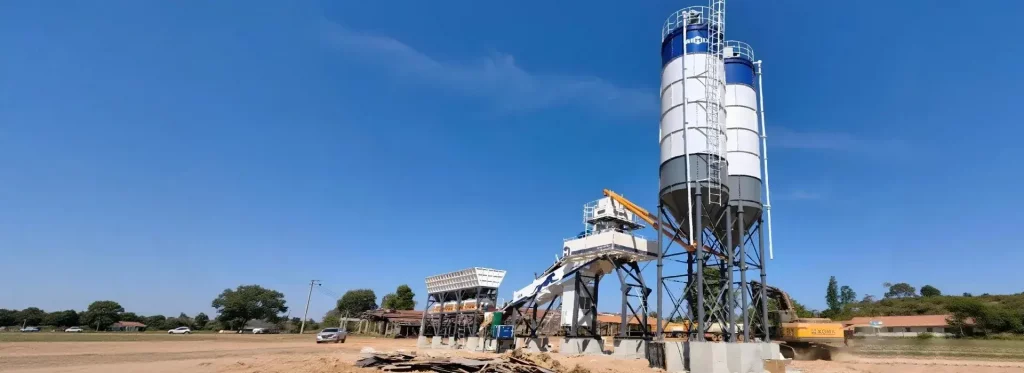
A contractor producing concrete on site may reduce dependence on long-distance ready-mix transportation. The contractor can also schedule production according to the actual pouring plan instead of waiting for external deliveries.
However, the contractor still needs to purchase raw materials and operate the equipment. Therefore, the plant does not eliminate concrete production costs. Instead, it changes how those costs are controlled.
Example: 2,000 m³ of Annual Concrete Demand
Consider a contractor that expects to produce approximately 2,000 m³ of concrete per year.
If on-site production provides a theoretical cost difference of $10 per m³ compared with delivered ready-mix concrete, the potential gross difference would be:
2,000 m³ × $10/m³ = $20,000 per year.
However, the $20,000 is not automatically the contractor’s net profit. The contractor must still deduct equipment depreciation, maintenance, operators, electricity, loading equipment, and other operating expenses.
This example demonstrates an important point: the higher the productive annual volume, the more important plant utilization becomes.
When Does Buying a Compact Concrete Batching Plant Make More Sense?
Several situations can make the investment more attractive. These situations usually relate to stable concrete demand and difficult external supply conditions.
1. The Project Is Far from a Ready-Mix Supplier
If ready-mix trucks need to travel long distances, transportation can affect both cost and reliability.
Producing concrete closer to the construction site can reduce the contractor’s dependence on long-distance delivery. It can also make the concrete supply schedule easier to coordinate with other construction activities.
2. The Contractor Has Several Projects
This is one of the strongest factors to consider.
A rmc plant for sale becomes more useful when the contractor can use it on multiple projects. Instead of recovering the investment from one construction site, the company can spread the equipment cost across several projects.
For example, a contractor may use the plant first for a warehouse project, then move it to a residential development, and later use it for an industrial foundation project.
As a result, the plant can become a long-term production asset rather than a machine used for only one project.
3. Concrete Demand Is Regular
Regular concrete demand improves equipment utilization.
If the contractor frequently needs concrete for foundations, columns, slabs, roads, drainage systems, or industrial construction, owning production equipment may provide more control than purchasing concrete for every project.
4. Concrete Scheduling Is Critical
Concrete placement often involves several teams at the same time. Workers, pumps, formwork, reinforcement, and other equipment may all depend on the concrete supply schedule.
If a ready-mix delivery arrives late, the contractor may face more than a simple delivery problem. Workers can wait. Concrete pumps can remain idle. Pouring schedules can shift.
Therefore, on-site production can provide operational value even when the direct concrete cost difference is not extremely large.
When Might Buying a Compact Batching Plant Not Be Profitable?
Buying a plant is not always the correct decision.
If a contractor only needs a few hundred cubic meters of concrete for one short project, the plant may not achieve enough utilization. The contractor would still need to pay for equipment, installation, operators, maintenance, and material handling.
Similarly, if the company has no confirmed projects after the current project, the equipment may remain idle.
Therefore, contractors should consider renting equipment or continuing to purchase ready-mix concrete when annual demand is low or highly uncertain.
The key issue is not whether the plant is technically suitable. The key issue is whether the company can keep the plant productive.
What Compact Plant Capacity Should Indonesian Contractors Consider?
Plant capacity should follow actual project demand.
A contractor should first estimate the required daily concrete volume and then calculate the required hourly production rate.
For example, if a project needs 240 m³ of concrete during an eight-hour production period:
240 m³ ÷ 8 hours = 30 m³/h average demand.
The contractor may then consider additional capacity for peak demand, maintenance downtime, truck coordination, and future projects.
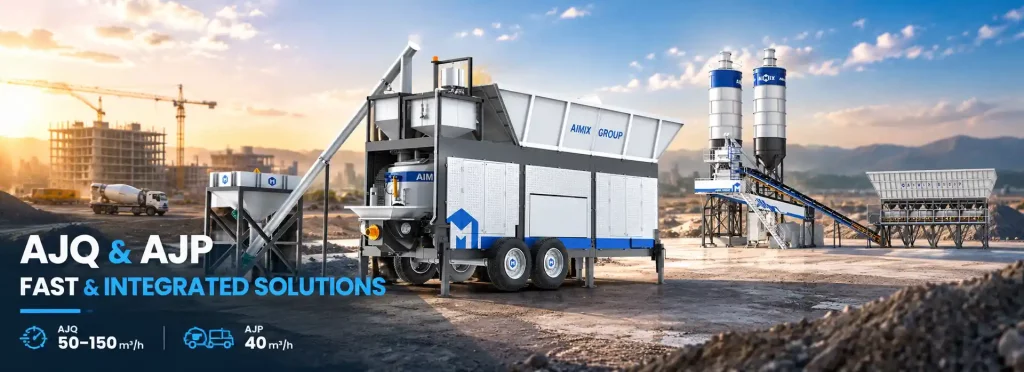
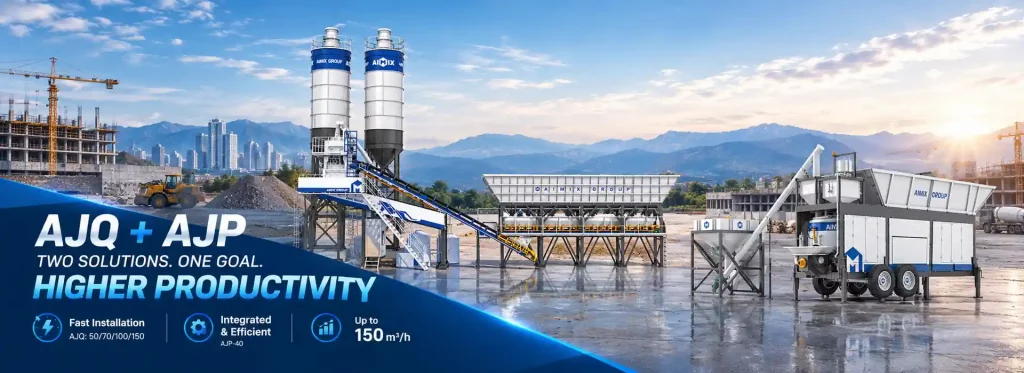
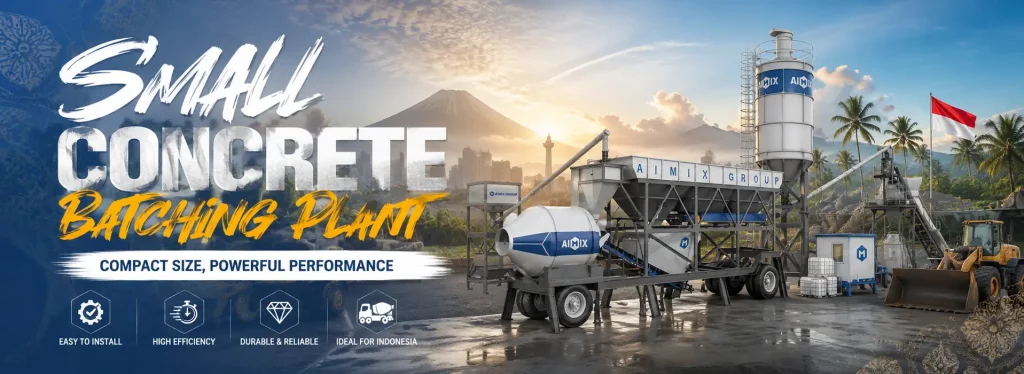
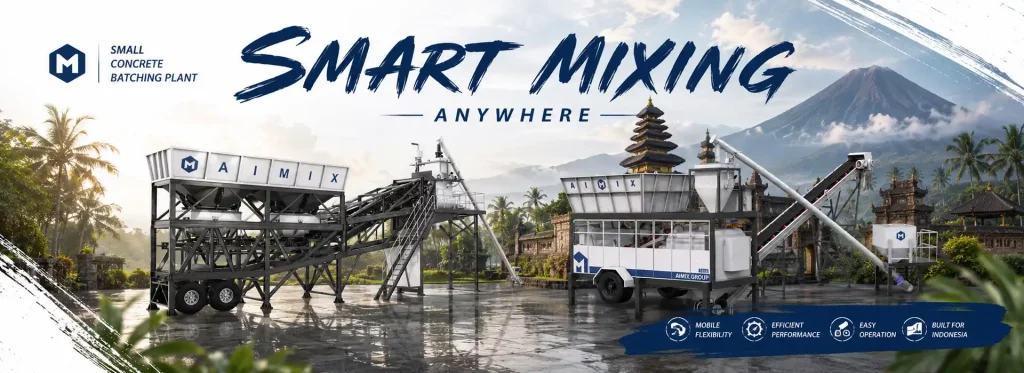
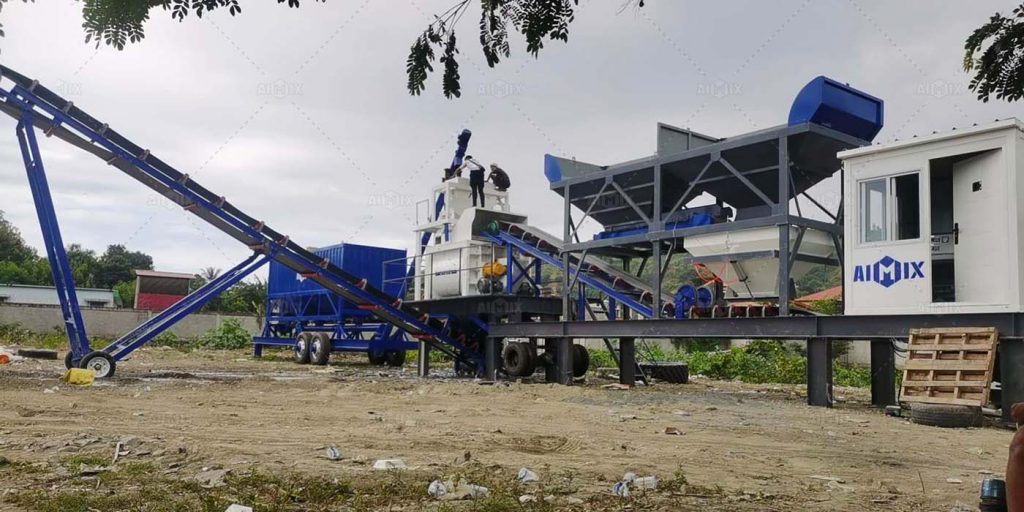
For small and medium projects, compact batching plants in capacities such as 50, 70, 100, or 150 m³/h can be evaluated depending on the actual application. For example, the AIMIX AJQ series offers configurations around these production levels.
However, choosing a 100 m³/h plant simply because it has a higher output does not automatically improve profitability. If the project only consumes 20–30 m³/h, much of that capacity may remain unused.
Therefore, the better question is not “What is the biggest plant I can buy?” but “What capacity can I keep productive?”
Compact Batching Plant vs. Buying Ready-Mix Concrete
For a small contractor, comparing the two business models can make the decision easier.
| Factor | Compact Batching Plant | Purchased Ready-Mix |
|---|---|---|
| Initial investment | Higher | Lower |
| Control over production | Higher | Depends on supplier |
| Dependence on external suppliers | Lower | Higher |
| Long-distance concrete delivery | Can be reduced | Usually required |
| Suitable for multiple projects | Yes | Yes |
| Idle equipment risk | Higher | Very low |
| Long-term production control | Higher | Lower |
Therefore, the better choice depends on the contractor’s workload. A company with stable demand may value production control and lower dependence on suppliers. A contractor with occasional concrete requirements may prefer the flexibility of buying ready-mix.
What Costs Should Be Included Before Buying?
A realistic calculation should include every major cost associated with producing concrete.
- Cement purchase cost
- Aggregate purchase and transportation
- Water supply
- Electricity or fuel
- Plant operator wages
- Loader or aggregate handling equipment
- Routine maintenance
- Wear parts and spare parts
- Site preparation
- Electrical installation
- Internal concrete transportation
- Plant relocation between projects
- Financing or loan costs
- Equipment depreciation
Including these items prevents contractors from creating an overly optimistic payback calculation.
How Can Small Contractors Improve the Return on Investment?
Once the contractor decides to purchase a plant, the next challenge is improving utilization. Several practical measures can help.
Use the Plant Across Multiple Projects
The more productive projects the plant serves, the easier it becomes to spread fixed ownership costs across total production.
Plan Aggregate and Cement Supply in Advance
Concrete production cannot continue smoothly if raw materials arrive late. Contractors should establish reliable local supply channels before production begins.
Match Production With Pouring Schedules
Producing more concrete than the project can place may create unnecessary material and handling issues. Production should therefore follow the actual pouring sequence.
Reduce Unplanned Downtime
Regular maintenance can help keep the plant available during important pouring periods. Spare parts availability also matters when the project operates far from major cities.
Evaluate the Complete Concrete Solution
A batching plant does not work alone. Depending on the project, the contractor may also need concrete mixers, concrete pumps, loaders, storage systems, or other equipment.
For example, if a project requires continuous production and pumping, the contractor should evaluate the batching and pumping process as one complete system. This approach can reveal bottlenecks that are not visible when each machine is considered separately.
What Should Contractors Check Before Purchasing?
Before placing an order, Indonesian contractors should answer several practical questions.
- How many cubic meters of concrete will be required annually?
- How many projects can use the plant?
- Where are the projects located?
- How far are reliable ready-mix suppliers?
- What is the average daily concrete requirement?
- What is the peak hourly demand?
- How long will each project last?
- Can the plant be relocated after project completion?
- Is enough space available for aggregates and equipment?
- What power supply is available?
- Who will operate the plant?
- How quickly can spare parts and technical support be provided?
- What is the expected production cost per cubic meter?
- How many months or years will be needed to recover the investment?
These questions help contractors move from a simple equipment purchase toward a real construction business calculation.
Is a Compact Concrete Batching Plant a Good Investment for Your Business?
A compact concrete batching plant can make financial sense for a small contractor in Indonesia when concrete demand is sufficient, projects are repeated, ready-mix delivery is expensive or unreliable, and the contractor can keep the plant productive.
On the other hand, low annual concrete demand, short project durations, and uncertain future workloads can make ownership less attractive.
Therefore, there is no single production capacity or investment level that fits every small contractor. The right choice depends on the contractor’s actual concrete volume, project locations, project duration, material costs, and future workload.
Calculate Your Concrete Demand Before You Buy
The most reliable way to evaluate a compact concrete batching plant is to start with your own project numbers.
Estimate your annual concrete demand. Compare the delivered cost of ready-mix concrete with the expected cost of producing concrete on site. Then include equipment ownership, labor, maintenance, material handling, and relocation costs.
If the numbers show sufficient utilization, a compact type batching plant machine can become more than another piece of construction equipment. It can become part of your company’s concrete production capability and support multiple projects over several years.
If you are planning a construction project in Indonesia, you can provide your project location, estimated concrete volume, project duration, daily concrete demand, and number of upcoming projects. AIMIX can then help you evaluate a suitable compact batching plant capacity and production configuration based on your actual construction requirements.
The right investment decision starts with your concrete demand, not simply the concrete plant price.
No responses yet