
For pavement projects, maintaining a stable and timely concrete supply is critical. Contractors often face tight schedules and limited resources, making equipment selection a key factor in project success. A common question arises: can a 6.5m³ self loading concrete mixer efficiently handle a pavement project that requires 100m³ of concrete per day?
Let’s analyze the practical capacity and suitability of the carmixer from a contractor’s perspective.

Production Capacity Of A 6.5m³ Self Loading Concrete Mixer
Understanding the production capability is the first step in evaluating the machine. Our 6.5m³ self loading concrete mixer produces 6.5 cubic meters per batch. Typically, a self loading mixer completes 4 cycles per hour under normal jobsite conditions.
Using this calculation:
6.5m³ per batch × 4 cycles per hour = 26m³ per hour
For a daily requirement of 100m³:
100m³ ÷ 26m³/h ≈ 3.85 hours
This means the machine only needs around four productive hours to meet the daily target. Even accounting for loading, transportation, and minor delays, the 6.5m³ mixer offers sufficient capacity for typical pavement projects.
Advantages For Pavement Projects
Pavement projects usually span long linear sections, requiring concrete delivery across multiple zones. Here, a self loading concrete mixer offers distinct advantages over traditional batching and delivery methods.
Mobility And On-Site Production
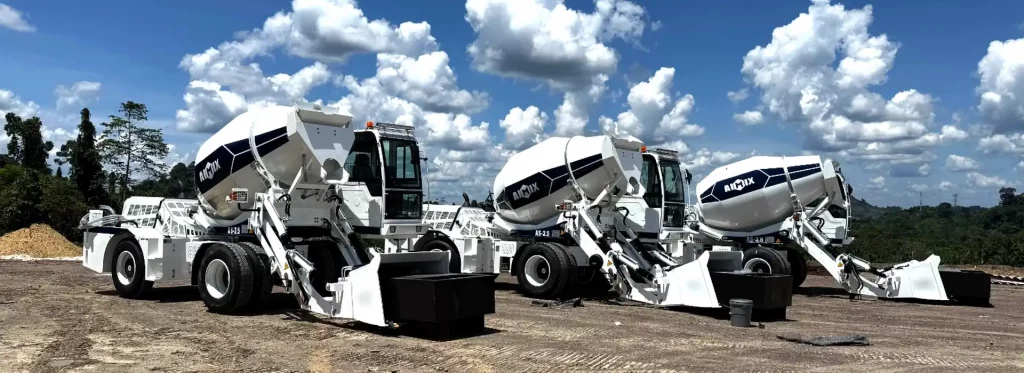
What is a self loading mixer? Since the self mixer combines loading, weighing, mixing, transporting, and discharging in one unit, operators can move it along the pavement line easily. This reduces transit time and ensures concrete remains fresh for placement.
Reduced Dependence On Ready-Mix Plants
Many pavement sites are distant from commercial concrete plants. Relying solely on ready-mix deliveries can lead to higher costs and delays. A 6.5m³ self loading mixer allows on-site production, giving contractors more control over scheduling and concrete quality.
Labor And Equipment Efficiency
By integrating multiple functions, the self loading mixer reduces the need for extra loaders, mixers, and manual labor. This saves costs and simplifies project management.
Realistic Daily Output
Let’s put the numbers into context. Assuming the project requires 100m³ per day:
- Hourly output: 26m³
- Effective working time: 4–5 hours
- Daily production potential: 100–130m³
Even if minor interruptions occur, a single 6.5m³ self loading mixer can comfortably achieve the target volume. The extra capacity provides flexibility during peak operations or unforeseen delays.
Factors Influencing Actual Performance
While the theoretical output is promising, site conditions impact actual production. Key factors include:
Material Stockpile Layout
Keeping aggregates, cement, and water close to the mixer reduces loading time and increases efficiency.
Road Conditions
Smoother internal haul roads allow faster cycles, while rough terrain may slow down operations.
Pouring Method And Pavement Width
Coordinating the mixer with paving crews ensures continuous concrete supply and reduces idle time.
Operator Experience
Skilled operators achieve consistent cycle times and higher daily outputs.

When To Consider Multiple Units
Although one 6.5m³ car mixer is adequate for 100m³/day projects, additional units may be necessary when:
- Daily demand exceeds 150m³
- Multiple pouring zones operate simultaneously
- Long on-site transport distances exist
- Deadlines are tight and production buffers are needed
For most municipal and industrial pavement projects, a single unit remains cost-effective and efficient.
Financial Benefits For Contractors
Beyond production, contractors gain financial advantages:
- Reduced ready-mix purchase and transport costs
- Fewer supporting machines required
- Lower labor expenses
- Greater flexibility to move the mixer between projects
These factors enhance ROI and overall project efficiency.

Conclusion
A 6.5m³ self loading concrete mixer is generally suitable for pavement projects requiring 100m³ per day. With an estimated 26m³ per hour output, it can meet daily requirements in around four working hours while offering mobility, cost savings, and operational flexibility.
If you plan to use a self loading mixer for your pavement project, contact our team. We provide expert advice to help you select the best equipment, optimize daily output, and ensure your project stays on schedule and budget.
No responses yet